Colleges by Location
Colleges by Fields of Study
Colleges by Tuition Range
Colleges by GPA Range
College by SAT Range
Colleges by ACT Score
Graduate Schools by Location
Graduate Schools by Fields of Study
Graduate School by Degree Type
Paying for Graduate School
Online Graduate Programs
Test Preparation
Career Planning
College Planning
Graduate School Planning
Applying to Graduate School
- More

| Median Wage (USD, 2024) | Projected Job Openings (2023-2033) | Projected Growth (2023-2033) | |
|---|---|---|---|
| National Statistics | $47,060 | 3000 | -8.9% |
| State Statistics | - | - | - |
| City Statistics | - | - | - |
Experience Requirements Overview
- Job Zone Two: Some Preparation Needed
- Some previous work-related skill, knowledge, or experience is usually needed. For example, a teller would benefit from experience working directly with the public.
- These occupations usually require a high school diploma.
- Employees in these occupations need anywhere from a few months to one year of working with experienced employees. A recognized apprenticeship program may be associated with these occupations.
Education, Training and Experience
Required Level of Education: Post-Secondary Certificate - awarded for training completed after high school (for example, in agriculture or natural resources, computer services, personal or culinary services, engineering technologies, healthcare, construction trades, mechanic and repair technologies, or precision production)
Related Work Experience: Over 6 months, up to and including 1 year
On-Site or In-Plant Training: Up to and including 1 month
On-the-Job Training: Anything beyond short demonstration, up to and including 1 month
Detailed Work Activities
- Enter commands, instructions, or specifications into equipment.
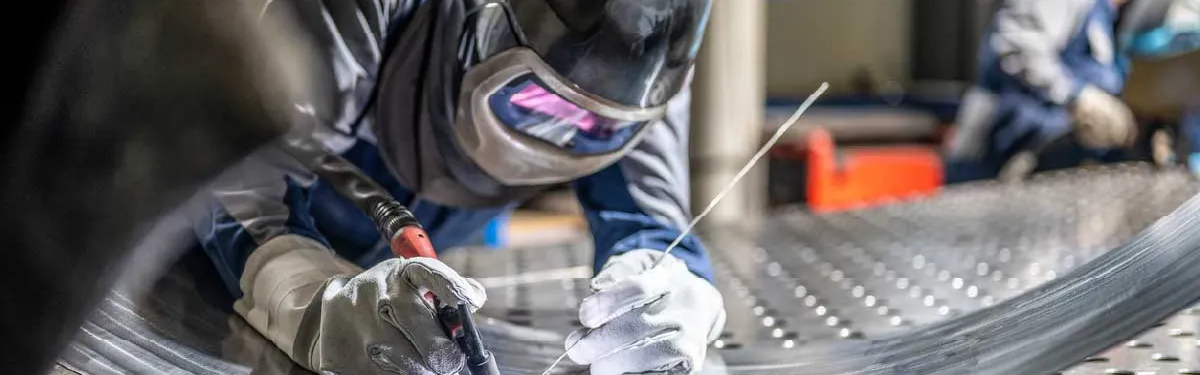
- Operate welding equipment.
- Load materials into production equipment.
- Feed materials or products into or through equipment.
- Direct operational or production activities.
Work Values
Achievement
Occupations that satisfy this work value are results oriented and allow employees to use their strongest abilities, giving them a feeling of accomplishment. Corresponding needs are Ability Utilization and Achievement.
Working Conditions
Recognition
Relationships
Support
Independence
Tasks
- Read blueprints, work orders, or production schedules to determine product or job instructions or specifications.
- Inspect, measure, or test completed metal workpieces to ensure conformance to specifications, using measuring and testing devices.
- Record operational information on specified production reports.
- Correct problems by adjusting controls or by stopping machines and opening holding devices.
- Set up, operate, or tend welding machines that join or bond components to fabricate metal products or assemblies.
- Select torch tips, alloys, flux, coil, tubing, or wire, according to metal types or thicknesses, data charts, or records.
- Lay out, fit, or connect parts to be bonded, calculating production measurements, as necessary.
- Prepare metal surfaces or workpieces, using hand-operated equipment, such as grinders, cutters, or drills.
- Mark weld points and positions of components on workpieces, using rules, squares, templates, or scribes.
- Set dials and timing controls to regulate electrical current, gas flow pressure, heating or cooling cycles, or shut-off.
- Turn and press knobs and buttons or enter operating instructions into computers to adjust and start welding machines.
- Assemble, align, and clamp workpieces into holding fixtures to bond, heat-treat, or solder fabricated metal components.
- Conduct trial runs before welding, soldering, or brazing, and make necessary adjustments to equipment.
- Give directions to other workers regarding machine set-up and use.
- Clean, lubricate, maintain, and adjust equipment to maintain efficient operation, using air hoses, cleaning fluids, and hand tools.
- Select, position, align, and bolt jigs, holding fixtures, guides, or stops onto machines, using measuring instruments and hand tools.
- Remove completed workpieces or parts from machinery, using hand tools.
- Observe meters, gauges, or machine operations to ensure that soldering or brazing processes meet specifications.
- Transfer components, metal products, or assemblies, using moving equipment.
- Devise or build fixtures or jigs used to hold parts in place during welding, brazing, or soldering.
- Add chemicals or materials to workpieces or machines to facilitate bonding or to cool workpieces.
- Tend auxiliary equipment used in welding processes.
- Compute and record settings for new work, applying knowledge of metal properties, principles of welding, and shop mathematics.
- Anneal finished workpieces to relieve internal stress.
- Load or feed workpieces into welding machines to join or bond components.
- Fill hoppers and position spouts to direct flow of flux or manually brush flux onto seams of workpieces.
- Start, monitor, and adjust robotic welding production lines.
- Dress electrodes, using tip dressers, files, emery cloths, or dressing wheels.
- Immerse completed workpieces into water or acid baths to cool and clean components.
Work Styles
Achievement/Effort
Job requires establishing and maintaining personally challenging achievement goals and exerting effort toward mastering tasks.
Persistence
Initiative
Leadership
Cooperation
Concern for Others
Social Orientation
Self-Control
Stress Tolerance
Adaptability/Flexibility
Dependability
Attention to Detail
Integrity
Independence
Innovation
Analytical Thinking
Data Source: This page includes information from the O*NET 30.0 Database by the U.S. Department of Labor, Employment and Training Administration (USDOL/ETA). Used under the CC BY 4.0 license. O*NET® is a trademark of USDOL/ETA. This page includes Employment Projections program, Occupational Employment and Wage Statistics program, U.S. Bureau of Labor Statistics.