Colleges by Location
Colleges by Fields of Study
Colleges by Tuition Range
Colleges by GPA Range
College by SAT Range
Colleges by ACT Score
Graduate Schools by Location
Graduate Schools by Fields of Study
Graduate School by Degree Type
Paying for Graduate School
Online Graduate Programs
Test Preparation
Career Planning
College Planning
Graduate School Planning
Applying to Graduate School
- More

| Median Wage (USD, 2024) | Projected Job Openings (2023-2033) | Projected Growth (2023-2033) | |
|---|---|---|---|
| National Statistics | $51,000 | 45800 | 2.0% |
| State Statistics | - | - | - |
| City Statistics | - | - | - |
Experience Requirements Overview
- Job Zone Two: Some Preparation Needed
- Some previous work-related skill, knowledge, or experience is usually needed. For example, a teller would benefit from experience working directly with the public.
- These occupations usually require a high school diploma.
- Employees in these occupations need anywhere from a few months to one year of working with experienced employees. A recognized apprenticeship program may be associated with these occupations.
Education, Training and Experience
Required Level of Education: High School Diploma - or the equivalent (for example, GED)
Related Work Experience: Over 1 year, up to and including 2 years
On-Site or In-Plant Training: Up to and including 1 month
On-the-Job Training: Over 1 month, up to and including 3 months
Detailed Work Activities
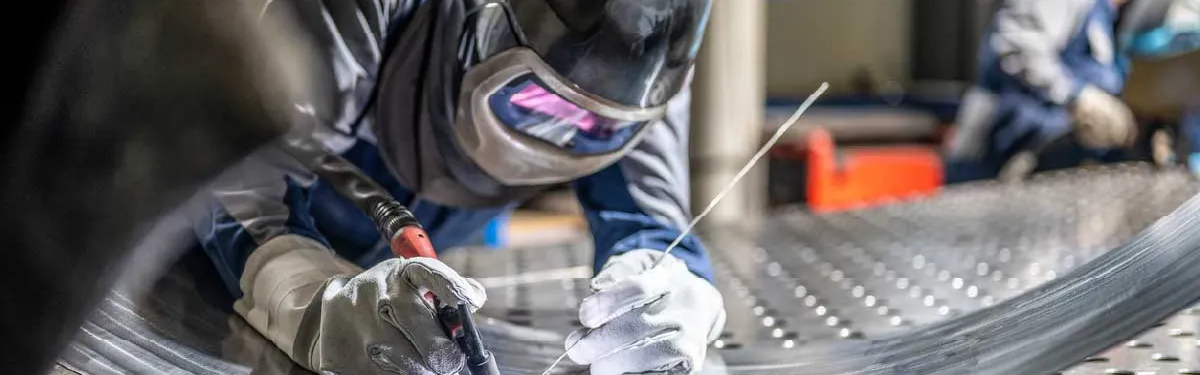
- Operate welding equipment.
- Maintain safety.
- Measure dimensions of completed products or workpieces to verify conformance to specifications.
- Operate welding equipment.
- Operate welding equipment.
Work Values
Achievement
Occupations that satisfy this work value are results oriented and allow employees to use their strongest abilities, giving them a feeling of accomplishment. Corresponding needs are Ability Utilization and Achievement.
Working Conditions
Recognition
Relationships
Support
Independence
Tasks
- Operate safety equipment and use safe work habits.
- Examine workpieces for defects and measure workpieces with straightedges or templates to ensure conformance with specifications.
- Weld components in flat, vertical, or overhead positions.
- Detect faulty operation of equipment or defective materials and notify supervisors.
- Recognize, set up, and operate hand and power tools common to the welding trade, such as shielded metal arc and gas metal arc welding equipment.
- Select and install torches, torch tips, filler rods, and flux, according to welding chart specifications or types and thicknesses of metals.
- Mark or tag material with proper job number, piece marks, and other identifying marks as required.
- Determine required equipment and welding methods, applying knowledge of metallurgy, geometry, and welding techniques.
- Prepare all material surfaces to be welded, ensuring that there is no loose or thick scale, slag, rust, moisture, grease, or other foreign matter.
- Align and clamp workpieces together, using rules, squares, or hand tools, or position items in fixtures, jigs, or vises.
- Connect and turn regulator valves to activate and adjust gas flow and pressure so that desired flames are obtained.
- Position and secure workpieces, using hoists, cranes, wire, and banding machines or hand tools.
- Melt and apply solder along adjoining edges of workpieces to solder joints, using soldering irons, gas torches, or electric-ultrasonic equipment.
- Monitor the fitting, burning, and welding processes to avoid overheating of parts or warping, shrinking, distortion, or expansion of material.
- Grind, cut, buff, or bend edges of workpieces to be joined to ensure snug fit, using power grinders and hand tools.
- Weld separately or in combination, using aluminum, stainless steel, cast iron, and other alloys.
- Chip or grind off excess weld, slag, or spatter, using hand scrapers or power chippers, portable grinders, or arc-cutting equipment.
- Develop templates and models for welding projects, using mathematical calculations based on blueprint information.
- Repair products by dismantling, straightening, reshaping, and reassembling parts, using cutting torches, straightening presses, and hand tools.
- Clean or degrease parts, using wire brushes, portable grinders, or chemical baths.
- Hammer out bulges or bends in metal workpieces.
- Check grooves, angles, or gap allowances, using micrometers, calipers, and precision measuring instruments.
- Melt and apply solder to fill holes, indentations, or seams of fabricated metal products, using soldering equipment.
- Ignite torches or start power supplies and strike arcs by touching electrodes to metals being welded, completing electrical circuits.
- Guide and direct flames or electrodes on or across workpieces to straighten, bend, melt, or build up metal.
- Use fire suppression methods in industrial emergencies.
- Preheat workpieces prior to welding or bending, using torches or heating furnaces.
- Set up and use ladders and scaffolding as necessary to complete work.
- Operate metal shaping, straightening, and bending machines, such as brakes and shears.
- Analyze engineering drawings, blueprints, specifications, sketches, work orders, and material safety data sheets to plan layout, assembly, and operations.
Work Styles
Achievement/Effort
Job requires establishing and maintaining personally challenging achievement goals and exerting effort toward mastering tasks.
Persistence
Initiative
Leadership
Cooperation
Concern for Others
Social Orientation
Self-Control
Stress Tolerance
Adaptability/Flexibility
Dependability
Attention to Detail
Integrity
Independence
Innovation
Analytical Thinking
Data Source: This page includes information from the O*NET 30.0 Database by the U.S. Department of Labor, Employment and Training Administration (USDOL/ETA). Used under the CC BY 4.0 license. O*NET® is a trademark of USDOL/ETA. This page includes Employment Projections program, Occupational Employment and Wage Statistics program, U.S. Bureau of Labor Statistics.