Colleges by Location
Colleges by Fields of Study
Colleges by Tuition Range
Colleges by GPA Range
College by SAT Range
Colleges by ACT Score
Graduate Schools by Location
Graduate Schools by Fields of Study
Graduate School by Degree Type
Paying for Graduate School
Online Graduate Programs
Test Preparation
Career Planning
College Planning
Graduate School Planning
Applying to Graduate School
- More

| Median Wage (USD, 2025) | Projected Job Openings (2025-2035) | Projected Growth (2025-2035) | |
|---|---|---|---|
| National Statistics | $62620 | 0 | 0.0% |
| State Statistics | - | - | - |
| City Statistics | - | - | - |
Experience Requirements Overview
- Job Zone 1-2: Very Little to Some Preparation Needed
- Some occupations may need little or no previous experience; others require several months to a year of experience. For example, landscaping and groundskeeping workers might require very little training or previous experience, while agricultural equipment operators can benefit from on-the job training.
- Usually requires a high school diploma or GED, though some occupations may not.
- Ranges from a few days to one year of on-the-job training.
Education, Training and Experience
Required Level of Education: High School Diploma or the equivalent (such as a GED)
Related Work Experience: Over 2 years, up to and including 4 years
On-Site or In-Plant Training: Over 3 months, up to and including 6 months
On-the-Job Training: Over 3 months, up to and including 6 months
Detailed Work Activities
- Assemble metal or plastic parts or products.
- Inspect timing devices.
- Repair precision devices or workpieces.
- Disassemble equipment for maintenance or repair.
- Clean workpieces or finished products.
Work Values
Achievement
Occupations that satisfy this work value are results oriented and allow employees to use their strongest abilities, giving them a feeling of accomplishment. Corresponding needs are Ability Utilization and Achievement.
Working Conditions
Recognition
Relationships
Support
Independence
Tasks
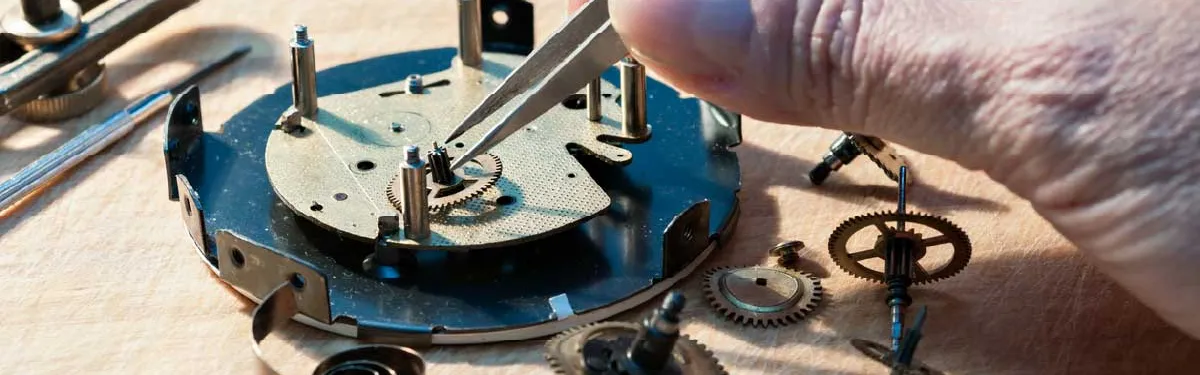
- Assemble and install components of timepieces to complete mechanisms, using watchmakers' tools and loupes.
- Observe operation of timepiece parts and subassemblies to determine accuracy of movement, and to diagnose causes of defects.
- Test operation and fit of timepiece parts and subassemblies, using electronic testing equipment, tweezers, watchmakers' tools, and loupes.
- Replace specified parts to repair malfunctioning timepieces, using watchmakers' tools, loupes, and holding fixtures.
- Disassemble timepieces such as watches, clocks, and chronometers so that repairs can be made.
- Clean and lubricate timepiece parts and assemblies, using solvents, buff sticks, and oil.
- Examine components of timepieces such as watches, clocks, or chronometers for defects, using loupes or microscopes.
- Bend parts, such as hairsprings, pallets, barrel covers, and bridges, to correct deficiencies in truing or endshake, using tweezers.
- Change timing weights on balance wheels to correct deficient timing.
- Adjust sizes or positioning of timepiece parts to achieve specified fit or function, using calipers, fixtures, and loupes.
- Mount hairsprings and balance wheel assemblies between jaws of truing calipers.
- Estimate spaces between collets and first inner coils to determine if spaces are within acceptable limits.
- Bend inner coils of springs away from or toward collets, using tweezers, to locate centers of collets in centers of springs, and to correct errors resulting from faulty colleting of coils.
- Turn wheels of calipers and examine springs, using loupes, to determine if center coils appear as perfect circles.
- Examine and adjust hairspring assemblies to ensure horizontal and circular alignment of hairsprings, using calipers, loupes, and watchmakers' tools.
- Review blueprints, sketches, or work orders to gather information about tasks to be completed.
- Tighten or replace loose jewels, using watchmakers' tools.
Work Styles
Innovation
A tendency to be inventive, to be imaginative, and to adopt new perspectives on ways to accomplish work.
Achievement Orientation
Intellectual Curiosity
Tolerance for Ambiguity
Initiative
Adaptability
Self-Confidence
Perseverance
Leadership Orientation
Humility
Sincerity
Empathy
Cooperation
Optimism
Social Orientation
Cautiousness
Attention to Detail
Dependability
Integrity
Stress Tolerance
Self-Control
Data Source: This page includes information from the O*NET 31.0 Database by the U.S. Department of Labor, Employment and Training Administration (USDOL/ETA). Used under the CC BY 4.0 license. O*NET® is a trademark of USDOL/ETA. This page includes Employment Projections program, Occupational Employment and Wage Statistics program, U.S. Bureau of Labor Statistics.