Colleges by Location
Colleges by Fields of Study
Colleges by Tuition Range
Colleges by GPA Range
College by SAT Range
Colleges by ACT Score
Graduate Schools by Location
Graduate Schools by Fields of Study
Graduate School by Degree Type
Paying for Graduate School
Online Graduate Programs
Test Preparation
Career Planning
College Planning
Graduate School Planning
Applying to Graduate School
- More

| Median Wage (USD, 2024) | Projected Job Openings (2023-2033) | Projected Growth (2023-2033) | |
|---|---|---|---|
| National Statistics | $48,630 | 2300 | -7.7% |
| State Statistics | - | - | - |
| City Statistics | - | - | - |
Experience Requirements Overview
- Job Zone Two: Some Preparation Needed
- Some previous work-related skill, knowledge, or experience is usually needed. For example, a teller would benefit from experience working directly with the public.
- These occupations usually require a high school diploma.
- Employees in these occupations need anywhere from a few months to one year of working with experienced employees. A recognized apprenticeship program may be associated with these occupations.
Education, Training and Experience
Required Level of Education: High School Diploma - or the equivalent (for example, GED)
Related Work Experience: N.A.
On-Site or In-Plant Training: Over 1 month, up to and including 3 months
On-the-Job Training: Over 1 month, up to and including 3 months
Detailed Work Activities
- Operate metal or plastic forming equipment.
- Watch operating equipment to detect malfunctions.
- Inspect metal, plastic, or composite products.
- Measure dimensions of completed products or workpieces to verify conformance to specifications.
- Read work orders or other instructions to determine product specifications or materials requirements.
Work Values
Achievement
Occupations that satisfy this work value are results oriented and allow employees to use their strongest abilities, giving them a feeling of accomplishment. Corresponding needs are Ability Utilization and Achievement.
Working Conditions
Recognition
Relationships
Support
Independence
Tasks
- Monitor machine cycles and mill operation to detect jamming and to ensure that products conform to specifications.
- Adjust and correct machine set-ups to reduce thicknesses, reshape products, and eliminate product defects.
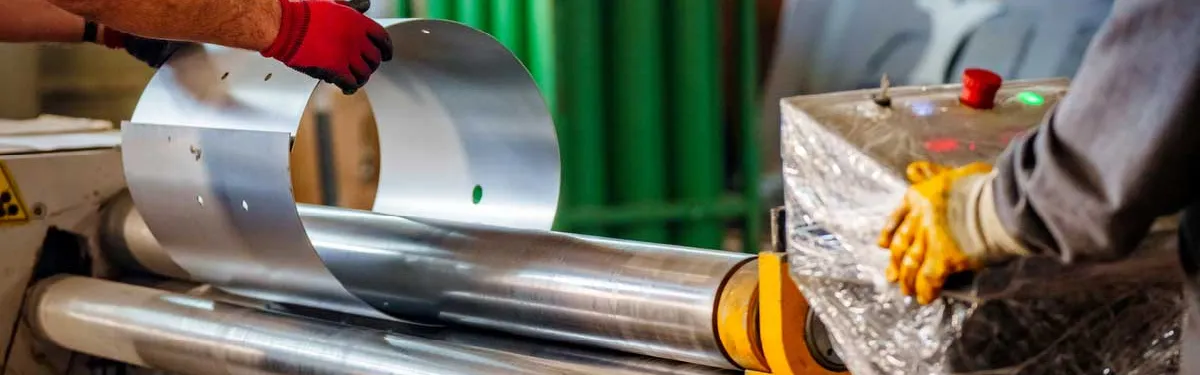
- Start operation of rolling and milling machines to flatten, temper, form, and reduce sheet metal sections and to produce steel strips.
- Examine, inspect, and measure raw materials and finished products to verify conformance to specifications.
- Read rolling orders, blueprints, and mill schedules to determine setup specifications, work sequences, product dimensions, and installation procedures.
- Manipulate controls and observe dial indicators to monitor, adjust, and regulate speeds of machine mechanisms.
- Set distance points between rolls, guides, meters, and stops, according to specifications.
- Calculate draft space and roll speed for each mill stand to plan rolling sequences and specified dimensions and tempers.
- Install equipment such as guides, guards, gears, cooling equipment, and rolls, using hand tools.
- Position, align, and secure arbors, spindles, coils, mandrels, dies, and slitting knives.
- Fill oil cups, adjust valves, and observe gauges to control flow of metal coolants and lubricants onto workpieces.
- Activate shears and grinders to trim workpieces.
- Signal and assist other workers to remove and position equipment, fill hoppers, and feed materials into machines.
- Record mill production on schedule sheets.
- Direct and train other workers to change rolls, operate mill equipment, remove coils and cobbles, and band and load material.
- Thread or feed sheets or rods through rolling mechanisms, or start and control mechanisms that automatically feed steel into rollers.
- Select rolls, dies, roll stands, and chucks from data charts to form specified contours and to fabricate products.
- Remove scratches and polish roll surfaces, using polishing stones and electric buffers.
- Disassemble sizing mills removed from rolling lines, and sort and store parts.
Work Styles
Leadership
Job requires a willingness to lead, take charge, and offer opinions and direction.
Achievement/Effort
Persistence
Initiative
Cooperation
Concern for Others
Social Orientation
Self-Control
Stress Tolerance
Adaptability/Flexibility
Dependability
Attention to Detail
Integrity
Independence
Innovation
Analytical Thinking
Data Source: This page includes information from the O*NET 30.0 Database by the U.S. Department of Labor, Employment and Training Administration (USDOL/ETA). Used under the CC BY 4.0 license. O*NET® is a trademark of USDOL/ETA. This page includes Employment Projections program, Occupational Employment and Wage Statistics program, U.S. Bureau of Labor Statistics.