Colleges by Location
Colleges by Fields of Study
Colleges by Tuition Range
Colleges by GPA Range
College by SAT Range
Colleges by ACT Score
Graduate Schools by Location
Graduate Schools by Fields of Study
Graduate School by Degree Type
Paying for Graduate School
Online Graduate Programs
Test Preparation
Career Planning
College Planning
Graduate School Planning
Applying to Graduate School
- More

| Median Wage (USD, 2024) | Projected Job Openings (2023-2033) | Projected Growth (2023-2033) | |
|---|---|---|---|
| National Statistics | $48,620 | 1700 | -11.4% |
| State Statistics | - | - | - |
| City Statistics | - | - | - |
Experience Requirements Overview
- Job Zone Two: Some Preparation Needed
- Some previous work-related skill, knowledge, or experience is usually needed. For example, a teller would benefit from experience working directly with the public.
- These occupations usually require a high school diploma.
- Employees in these occupations need anywhere from a few months to one year of working with experienced employees. A recognized apprenticeship program may be associated with these occupations.
Education, Training and Experience
Required Level of Education: High School Diploma - or the equivalent (for example, GED)
Related Work Experience: Over 1 year, up to and including 2 years
On-Site or In-Plant Training: Over 6 months, up to and including 1 year
On-the-Job Training: Over 6 months, up to and including 1 year
Detailed Work Activities
- Measure dimensions of completed products or workpieces to verify conformance to specifications.
- Read work orders or other instructions to determine product specifications or materials requirements.
- Review blueprints or other instructions to determine operational methods or sequences.
- Operate metal or plastic forming equipment.
- Set equipment controls to meet cutting specifications.
Work Values
Achievement
Occupations that satisfy this work value are results oriented and allow employees to use their strongest abilities, giving them a feeling of accomplishment. Corresponding needs are Ability Utilization and Achievement.
Working Conditions
Recognition
Relationships
Support
Independence
Tasks
- Adjust machine controls and change tool settings to keep dimensions within specified tolerances.
- Move controls to set cutting speeds and depths and feed rates, and to position tools in relation to workpieces.
- Study blueprints, layouts or charts, and job orders for information on specifications and tooling instructions, and to determine material requirements and operational sequences.
- Inspect sample workpieces to verify conformance with specifications, using instruments such as gauges, micrometers, and dial indicators.
- Replace worn tools, and sharpen dull cutting tools and dies, using bench grinders or cutter-grinding machines.
- Move toolholders manually or by turning handwheels, or engage automatic feeding mechanisms to feed tools to and along workpieces.
- Compute unspecified dimensions and machine settings, using knowledge of metal properties and shop mathematics.
- Crank machines through cycles, stopping to adjust tool positions and machine controls to ensure specified timing, clearances, and tolerances.
- Position, secure, and align cutting tools in toolholders on machines, using hand tools, and verify their positions with measuring instruments.
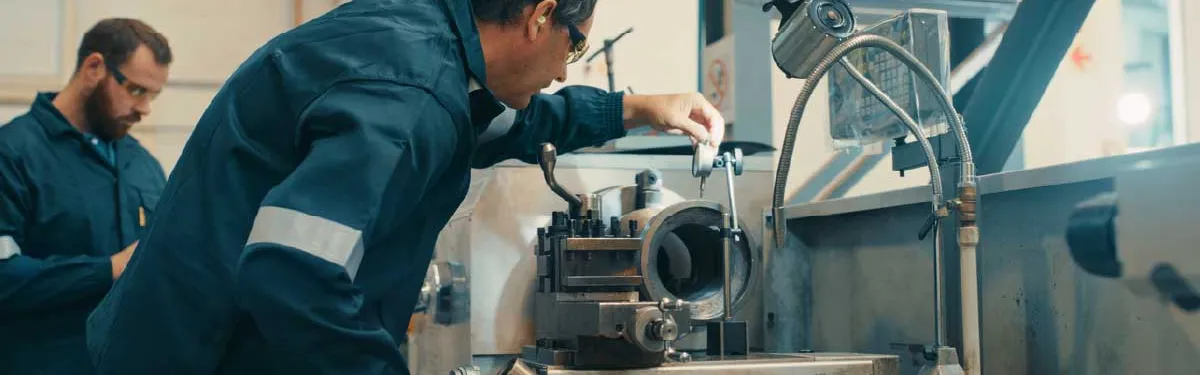
- Start lathe or turning machines and observe operations to ensure that specifications are met.
- Program computer numerical control machines.
- Refill, change, and monitor the level of fluids, such as oil and coolant, in machines.
- Clean work area.
- Lift metal stock or workpieces manually or using hoists, and position and secure them in machines, using fasteners and hand tools.
- Install holding fixtures, cams, gears, and stops to control stock and tool movement, using hand tools, power tools, and measuring instruments.
- Select cutting tools and tooling instructions, according to written specifications or knowledge of metal properties and shop mathematics.
- Mount attachments, such as relieving or tracing attachments, to perform operations, such as duplicating contours of templates or trimming workpieces.
- Turn valve handles to direct the flow of coolant onto work areas or to coat disks with spinning compounds.
Work Styles
Achievement/Effort
Job requires establishing and maintaining personally challenging achievement goals and exerting effort toward mastering tasks.
Persistence
Initiative
Leadership
Cooperation
Concern for Others
Social Orientation
Self-Control
Stress Tolerance
Adaptability/Flexibility
Dependability
Attention to Detail
Integrity
Independence
Innovation
Analytical Thinking
Data Source: This page includes information from the O*NET 30.0 Database by the U.S. Department of Labor, Employment and Training Administration (USDOL/ETA). Used under the CC BY 4.0 license. O*NET® is a trademark of USDOL/ETA. This page includes Employment Projections program, Occupational Employment and Wage Statistics program, U.S. Bureau of Labor Statistics.