Colleges by Location
Colleges by Fields of Study
Colleges by Tuition Range
Colleges by GPA Range
College by SAT Range
Colleges by ACT Score
Graduate Schools by Location
Graduate Schools by Fields of Study
Graduate School by Degree Type
Paying for Graduate School
Online Graduate Programs
Test Preparation
Career Planning
College Planning
Graduate School Planning
Applying to Graduate School
- More

| Median Wage (USD, 2025) | Projected Job Openings (2025-2035) | Projected Growth (2025-2035) | |
|---|---|---|---|
| National Statistics | $46680 | 8100 | -1.5% |
| State Statistics | - | - | - |
| City Statistics | - | - | - |
Experience Requirements Overview
- Job Zone 1-2: Very Little to Some Preparation Needed
- Some occupations may need little or no previous experience; others require several months to a year of experience. For example, landscaping and groundskeeping workers might require very little training or previous experience, while agricultural equipment operators can benefit from on-the job training.
- Usually requires a high school diploma or GED, though some occupations may not.
- Ranges from a few days to one year of on-the-job training.
Education, Training and Experience
Required Level of Education: High School Diploma or the equivalent (such as a GED)
Related Work Experience: Over 1 month, up to and including 3 months
On-Site or In-Plant Training: Over 1 month, up to and including 3 months
On-the-Job Training: Over 1 month, up to and including 3 months
Detailed Work Activities
- Assemble wood products.
- Measure dimensions of completed products or workpieces to verify conformance to specifications.
- Operate woodworking equipment.
- Measure materials to mark reference points, cutting lines, or other indicators.
- Read work orders or other instructions to determine product specifications or materials requirements.
Work Values
Achievement
Occupations that satisfy this work value are results oriented and allow employees to use their strongest abilities, giving them a feeling of accomplishment. Corresponding needs are Ability Utilization and Achievement.
Working Conditions
Recognition
Relationships
Support
Independence
Tasks
- Verify dimensions or check the quality or fit of pieces to ensure adherence to specifications.
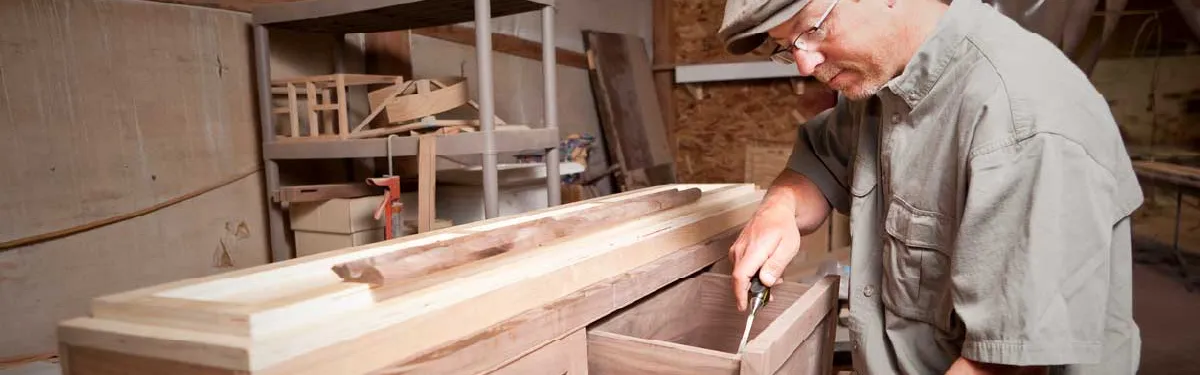
- Produce or assemble components of articles, such as store fixtures, office equipment, cabinets, or high-grade furniture.
- Trim, sand, or scrape surfaces or joints to prepare articles for finishing.
- Measure and mark dimensions of parts on paper or lumber stock prior to cutting, following blueprints, to ensure a tight fit and quality product.
- Cut timber to the right size, and shape and trim parts of joints to ensure a snug fit, using hand tools, such as planes, chisels, or wood files.
- Match materials for color, grain, or texture, giving attention to knots or other features of the wood.
- Set up or operate machines, including power saws, jointers, mortisers, tenoners, molders, or shapers, to cut, mold, or shape woodstock or wood substitutes.
- Establish the specifications of articles to be constructed or repaired, or plan the methods or operations for shaping or assembling parts, based on blueprints, drawings, diagrams, or oral or written instructions.
- Bore holes for insertion of screws or dowels, by hand or using boring machines.
- Attach parts or subassemblies together to form completed units, using glue, dowels, nails, screws, or clamps.
- Reinforce joints with nails or other fasteners to prepare articles for finishing.
- Install hardware, such as hinges, handles, catches, or drawer pulls, using hand tools.
- Perform final touch-ups with sandpaper or steel wool.
- Repair or alter wooden furniture, cabinetry, fixtures, paneling, or other pieces.
- Design furniture, using computer-aided drawing programs.
- Program computers to operate machinery.
- Dip, brush, or spray assembled articles with protective or decorative finishes, such as stain, varnish, paint, or lacquer.
- Draw up detailed specifications and discuss projects with customers.
- Estimate the amounts, types, or costs of needed materials.
- Apply Masonite, formica, or vinyl surfacing materials.
Work Styles
Innovation
A tendency to be inventive, to be imaginative, and to adopt new perspectives on ways to accomplish work.
Achievement Orientation
Intellectual Curiosity
Tolerance for Ambiguity
Initiative
Adaptability
Self-Confidence
Perseverance
Leadership Orientation
Humility
Sincerity
Empathy
Cooperation
Optimism
Social Orientation
Cautiousness
Attention to Detail
Dependability
Integrity
Stress Tolerance
Self-Control
Data Source: This page includes information from the O*NET 31.0 Database by the U.S. Department of Labor, Employment and Training Administration (USDOL/ETA). Used under the CC BY 4.0 license. O*NET® is a trademark of USDOL/ETA. This page includes Employment Projections program, Occupational Employment and Wage Statistics program, U.S. Bureau of Labor Statistics.