Colleges by Location
Colleges by Fields of Study
Colleges by Tuition Range
Colleges by GPA Range
College by SAT Range
Colleges by ACT Score
Graduate Schools by Location
Graduate Schools by Fields of Study
Graduate School by Degree Type
Paying for Graduate School
Online Graduate Programs
Test Preparation
Career Planning
College Planning
Graduate School Planning
Applying to Graduate School
- More

| Median Wage (USD, 2024) | Projected Job Openings (2023-2033) | Projected Growth (2023-2033) | |
|---|---|---|---|
| National Statistics | $39,020 | 3200 | -15.1% |
| State Statistics | - | - | - |
| City Statistics | - | - | - |
Experience Requirements Overview
- Job Zone Two: Some Preparation Needed
- Some previous work-related skill, knowledge, or experience is usually needed. For example, a teller would benefit from experience working directly with the public.
- These occupations usually require a high school diploma.
- Employees in these occupations need anywhere from a few months to one year of working with experienced employees. A recognized apprenticeship program may be associated with these occupations.
Education, Training and Experience
Required Level of Education: High School Diploma - or the equivalent (for example, GED)
Related Work Experience: N.A.
On-Site or In-Plant Training: N.A.
On-the-Job Training: Anything beyond short demonstration, up to and including 1 month
Detailed Work Activities
- Read work orders to determine material or setup requirements.
- Operate office equipment.
- Operate office equipment.
- Calculate costs of goods or services.
- Provide information to coworkers.
Work Values
Achievement
Occupations that satisfy this work value are results oriented and allow employees to use their strongest abilities, giving them a feeling of accomplishment. Corresponding needs are Ability Utilization and Achievement.
Working Conditions
Recognition
Relationships
Support
Independence
Tasks
- Read job orders to determine the type of work to be done, the quantities to be produced, and the materials needed.
- Deliver completed work.
- Place original copies in feed trays, feed originals into feed rolls, or position originals on tables beneath camera lenses.
- Sort, assemble, and proof completed work.
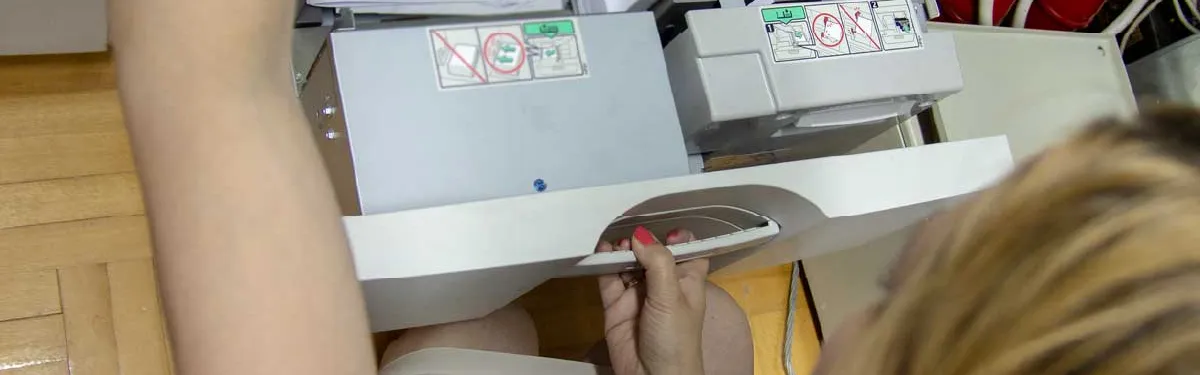
- Operate office machines such as high speed business photocopiers, readers, scanners, addressing machines, stencil-cutting machines, microfilm readers or printers, folding and inserting machines, bursters, and binder machines.
- Complete records of production, including work volumes and outputs, materials used, and any backlogs.
- Compute prices for services and receive payment, or provide supervisors with billing information.
- Set up and adjust machines, regulating factors such as speed, ink flow, focus, and number of copies.
- Load machines with materials such as blank paper or film.
- Monitor machine operation, and make adjustments as necessary to ensure proper operation.
- Clean machines, perform minor repairs, and report major repair needs.
- File and store completed documents.
- Operate auxiliary machines such as collators, pad and tablet making machines, staplers, and paper punching, folding, cutting, and perforating machines.
- Maintain stock of supplies, and requisition any needed items.
- Prepare and process papers for use in scanning, microfilming, and microfiche.
- Clean and file master copies or plates.
- Cut copies apart and write identifying information, such as page numbers or titles, on copies.
- Move heat units and clamping frames over screen beds to form Braille impressions on pages, raising frames to release individual copies.
Work Styles
Achievement/Effort
Job requires establishing and maintaining personally challenging achievement goals and exerting effort toward mastering tasks.
Persistence
Initiative
Leadership
Cooperation
Concern for Others
Social Orientation
Self-Control
Stress Tolerance
Adaptability/Flexibility
Dependability
Attention to Detail
Integrity
Independence
Innovation
Analytical Thinking
Data Source: This page includes information from the O*NET 30.0 Database by the U.S. Department of Labor, Employment and Training Administration (USDOL/ETA). Used under the CC BY 4.0 license. O*NET® is a trademark of USDOL/ETA. This page includes Employment Projections program, Occupational Employment and Wage Statistics program, U.S. Bureau of Labor Statistics.