Colleges by Location
Colleges by Fields of Study
Colleges by Tuition Range
Colleges by GPA Range
College by SAT Range
Colleges by ACT Score
Graduate Schools by Location
Graduate Schools by Fields of Study
Graduate School by Degree Type
Paying for Graduate School
Online Graduate Programs
Test Preparation
Career Planning
College Planning
Graduate School Planning
Applying to Graduate School
- More

| Median Wage (USD, 2024) | Projected Job Openings (2023-2033) | Projected Growth (2023-2033) | |
|---|---|---|---|
| National Statistics | $46,710 | 700 | -1.5% |
| State Statistics | - | - | - |
| City Statistics | - | - | - |
Experience Requirements Overview
- Job Zone Two: Some Preparation Needed
- Some previous work-related skill, knowledge, or experience is usually needed. For example, a teller would benefit from experience working directly with the public.
- These occupations usually require a high school diploma.
- Employees in these occupations need anywhere from a few months to one year of working with experienced employees. A recognized apprenticeship program may be associated with these occupations.
Education, Training and Experience
Required Level of Education: High School Diploma - or the equivalent (for example, GED)
Related Work Experience: Over 1 year, up to and including 2 years
On-Site or In-Plant Training: Up to and including 1 month
On-the-Job Training: Over 1 month, up to and including 3 months
Detailed Work Activities
- Direct material handling or moving activities.
- Evaluate log quality.
- Record agricultural or forestry inventory data.
- Mark agricultural or forestry products for identification.
- Measure physical characteristics of forestry or agricultural products.
Work Values
Achievement
Occupations that satisfy this work value are results oriented and allow employees to use their strongest abilities, giving them a feeling of accomplishment. Corresponding needs are Ability Utilization and Achievement.
Working Conditions
Recognition
Relationships
Support
Independence
Tasks
- Evaluate log characteristics and determine grades, using established criteria.
- Record data about individual trees or load volumes into tally books or hand-held collection terminals.
- Measure felled logs or loads of pulpwood to calculate volume, weight, dimensions, and marketable value, using measuring devices and conversion tables.
- Paint identification marks of specified colors on logs to identify grades or species, using spray cans, or call out grades to log markers.
- Jab logs with metal ends of scale sticks, and inspect logs to ascertain characteristics or defects such as water damage, splits, knots, broken ends, rotten areas, twists, and curves.
- Identify logs of substandard or special grade so that they can be returned to shippers, regraded, recut, or transferred for other processing.
- Arrange for hauling of logs to appropriate mill sites.
- Weigh log trucks before and after unloading, and record load weights and supplier identities.
- Measure log lengths and mark boles for bucking into logs, according to specifications.
- Communicate with coworkers by signals to direct log movement.
- Drive to sawmills, wharfs, or skids to inspect logs or pulpwood.
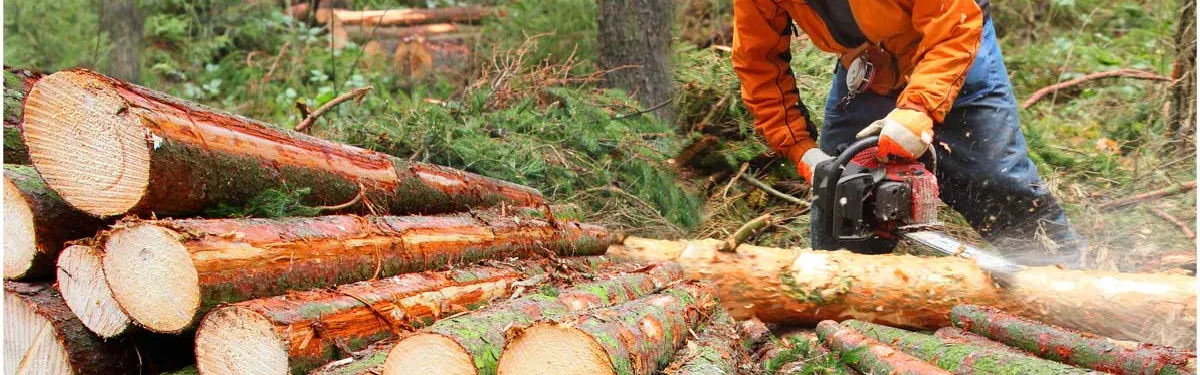
- Saw felled trees into lengths.
Work Styles
Achievement/Effort
Job requires establishing and maintaining personally challenging achievement goals and exerting effort toward mastering tasks.
Persistence
Initiative
Leadership
Cooperation
Concern for Others
Social Orientation
Self-Control
Stress Tolerance
Adaptability/Flexibility
Dependability
Attention to Detail
Integrity
Independence
Innovation
Analytical Thinking
Data Source: This page includes information from the O*NET 30.0 Database by the U.S. Department of Labor, Employment and Training Administration (USDOL/ETA). Used under the CC BY 4.0 license. O*NET® is a trademark of USDOL/ETA. This page includes Employment Projections program, Occupational Employment and Wage Statistics program, U.S. Bureau of Labor Statistics.