Colleges by Location
Colleges by Fields of Study
Colleges by Tuition Range
Colleges by GPA Range
College by SAT Range
Colleges by ACT Score
Graduate Schools by Location
Graduate Schools by Fields of Study
Graduate School by Degree Type
Paying for Graduate School
Online Graduate Programs
Test Preparation
Career Planning
College Planning
Graduate School Planning
Applying to Graduate School
- More

| Median Wage (USD, 2024) | Projected Job Openings (2023-2033) | Projected Growth (2023-2033) | |
|---|---|---|---|
| National Statistics | $49,490 | 4100 | 7.0% |
| State Statistics | - | - | - |
| City Statistics | - | - | - |
Experience Requirements Overview
- Job Zone Four: Considerable Preparation Needed
- A considerable amount of work-related skill, knowledge, or experience is needed for these occupations. For example, an accountant must complete four years of college and work for several years in accounting to be considered qualified.
- Most of these occupations require a four-year bachelor's degree, but some do not.
- Employees in these occupations usually need several years of work-related experience, on-the-job training, and/or vocational training.
Education, Training and Experience
Required Level of Education: Bachelor's Degree
Related Work Experience: N.A.
On-Site or In-Plant Training: N.A.
On-the-Job Training: Over 6 months, up to and including 1 year
Detailed Work Activities
- Prepare scientific or technical reports or presentations.
- Record research or operational data.
- Collect environmental data or samples.
- Advise others on matters of public policy.
- Calibrate scientific or technical equipment.
Work Values
Achievement
Occupations that satisfy this work value are results oriented and allow employees to use their strongest abilities, giving them a feeling of accomplishment. Corresponding needs are Ability Utilization and Achievement.
Working Conditions
Recognition
Relationships
Support
Independence
Tasks
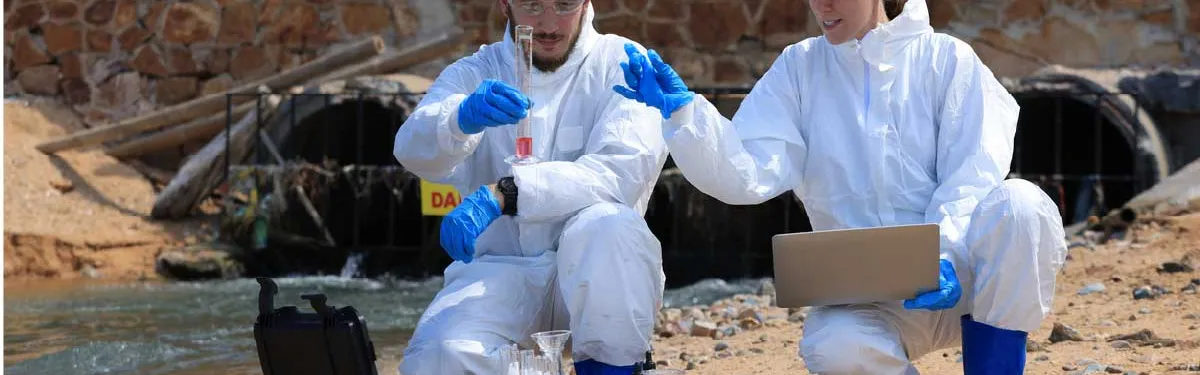
- Collect samples of gases, soils, water, industrial wastewater, or asbestos products to conduct tests on pollutant levels or identify sources of pollution.
- Investigate hazardous conditions or spills or outbreaks of disease or food poisoning, collecting samples for analysis.
- Record test data and prepare reports, summaries, or charts that interpret test results.
- Prepare samples or photomicrographs for testing and analysis.
- Discuss test results and analyses with customers.
- Inspect workplaces to ensure the absence of health and safety hazards, such as high noise levels, radiation, or potential lighting hazards.
- Weigh, analyze, or measure collected sample particles, such as lead, coal dust, or rock, to determine concentration of pollutants.
- Calibrate microscopes or test instruments.
- Provide information or technical or program assistance to government representatives, employers, or the general public on the issues of public health, environmental protection, or workplace safety.
- Maintain files, such as hazardous waste databases, chemical usage data, personnel exposure information, or diagrams showing equipment locations.
- Set up equipment or stations to monitor and collect pollutants from sites, such as smoke stacks, manufacturing plants, or mechanical equipment.
- Develop or implement programs for monitoring of environmental pollution or radiation.
- Monitor emission control devices to ensure they are operating properly and comply with state and federal regulations.
- Make recommendations to control or eliminate unsafe conditions at workplaces or public facilities.
- Calculate amount of pollutant in samples or compute air pollution or gas flow in industrial processes, using chemical and mathematical formulas.
- Develop testing procedures.
- Perform statistical analysis of environmental data.
- Develop or implement site recycling or hazardous waste stream programs.
- Direct activities of workers in laboratory.
- Analyze potential environmental impacts of production process changes, and recommend steps to mitigate negative impacts.
- Initiate procedures to close down or fine establishments violating environmental or health regulations.
- Inspect sanitary conditions at public facilities.
- Determine amounts and kinds of chemicals to use in destroying harmful organisms or removing impurities from purification systems.
- Examine and analyze material for presence and concentration of contaminants, such as asbestos, using variety of microscopes.
- Distribute permits, closure plans, or cleanup plans.
Work Styles
Achievement/Effort
Job requires establishing and maintaining personally challenging achievement goals and exerting effort toward mastering tasks.
Persistence
Initiative
Leadership
Cooperation
Concern for Others
Social Orientation
Self-Control
Stress Tolerance
Adaptability/Flexibility
Dependability
Attention to Detail
Integrity
Independence
Innovation
Analytical Thinking
Data Source: This page includes information from the O*NET 30.0 Database by the U.S. Department of Labor, Employment and Training Administration (USDOL/ETA). Used under the CC BY 4.0 license. O*NET® is a trademark of USDOL/ETA. This page includes Employment Projections program, Occupational Employment and Wage Statistics program, U.S. Bureau of Labor Statistics.