Colleges by Location
Colleges by Fields of Study
Colleges by Tuition Range
Colleges by GPA Range
College by SAT Range
Colleges by ACT Score
Graduate Schools by Location
Graduate Schools by Fields of Study
Graduate School by Degree Type
Paying for Graduate School
Online Graduate Programs
Test Preparation
Career Planning
College Planning
Graduate School Planning
Applying to Graduate School
- More

| Median Wage (USD, 2024) | Projected Job Openings (2023-2033) | Projected Growth (2023-2033) | |
|---|---|---|---|
| National Statistics | $82,730 | 700 | 6.9% |
| State Statistics | - | - | - |
| City Statistics | - | - | - |
Experience Requirements Overview
- Job Zone Three: Medium Preparation Needed
- Previous work-related skill, knowledge, or experience is required for these occupations. For example, an electrician must have completed three or four years of apprenticeship or several years of vocational training, and often must have passed a licensing exam, in order to perform the job.
- Most occupations in this zone require training in vocational schools, related on-the-job experience, or an associate's degree.
- Employees in these occupations usually need one or two years of training involving both on-the-job experience and informal training with experienced workers. A recognized apprenticeship program may be associated with these occupations.
Education, Training and Experience
Required Level of Education: Post-Secondary Certificate - awarded for training completed after high school (for example, in agriculture or natural resources, computer services, personal or culinary services, engineering technologies, healthcare, construction trades, mechanic and repair technologies, or precision production)
Related Work Experience: Over 1 year, up to and including 2 years
On-Site or In-Plant Training: Over 3 months, up to and including 6 months
On-the-Job Training: Over 3 months, up to and including 6 months
Detailed Work Activities
- Inspect electrical or electronic systems for defects.
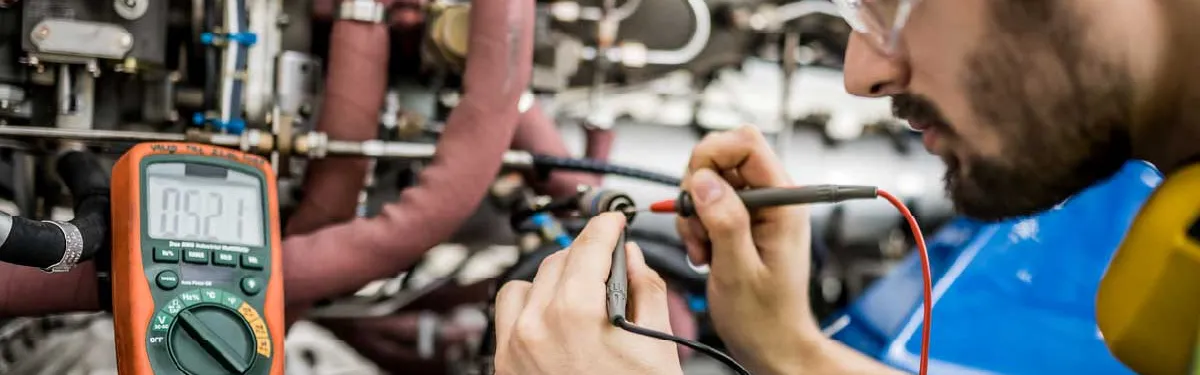
- Test electrical equipment or systems to ensure proper functioning.
- Test electrical circuits or components for proper functioning.
- Reassemble equipment after repair.
- Connect electrical components or equipment.
Work Values
Achievement
Occupations that satisfy this work value are results oriented and allow employees to use their strongest abilities, giving them a feeling of accomplishment. Corresponding needs are Ability Utilization and Achievement.
Working Conditions
Recognition
Relationships
Support
Independence
Tasks
- Reassemble and test equipment after repairs.
- Inspect and test electrical systems and equipment to locate and diagnose malfunctions, using visual inspections, testing devices, and computer software.
- Adjust, repair, or replace defective wiring and relays in ignition, lighting, air-conditioning, and safety control systems, using electrician's tools.
- Splice wires with knives or cutting pliers, and solder connections to fixtures, outlets, and equipment.
- Locate and remove or repair circuit defects such as blown fuses or malfunctioning transistors.
- Maintain equipment service records.
- Refer to schematics and manufacturers' specifications that show connections and provide instructions on how to locate problems.
- Install fixtures, outlets, terminal boards, switches, and wall boxes, using hand tools.
- Install new fuses, electrical cables, or power sources as required.
- Cut openings and drill holes for fixtures, outlet boxes, and fuse holders, using electric drills and routers.
- Confer with customers to determine the nature of malfunctions.
- Install electrical equipment such as air-conditioning, heating, or ignition systems and components such as generator brushes and commutators, using hand tools.
- Repair or rebuild equipment such as starters, generators, distributors, or door controls, using electrician's tools.
- Estimate costs of repairs based on parts and labor requirements.
- Measure, cut, and install frameworks and conduit to support and connect wiring, control panels, and junction boxes, using hand tools.
Work Styles
Achievement/Effort
Job requires establishing and maintaining personally challenging achievement goals and exerting effort toward mastering tasks.
Persistence
Initiative
Leadership
Cooperation
Concern for Others
Social Orientation
Self-Control
Stress Tolerance
Adaptability/Flexibility
Dependability
Attention to Detail
Integrity
Independence
Innovation
Analytical Thinking
Data Source: This page includes information from the O*NET 30.0 Database by the U.S. Department of Labor, Employment and Training Administration (USDOL/ETA). Used under the CC BY 4.0 license. O*NET® is a trademark of USDOL/ETA. This page includes Employment Projections program, Occupational Employment and Wage Statistics program, U.S. Bureau of Labor Statistics.