Colleges by Location
Colleges by Fields of Study
Colleges by Tuition Range
Colleges by GPA Range
College by SAT Range
Colleges by ACT Score
Graduate Schools by Location
Graduate Schools by Fields of Study
Graduate School by Degree Type
Paying for Graduate School
Online Graduate Programs
Test Preparation
Career Planning
College Planning
Graduate School Planning
Applying to Graduate School
- More

| Median Wage (USD, 2024) | Projected Job Openings (2023-2033) | Projected Growth (2023-2033) | |
|---|---|---|---|
| National Statistics | $51,860 | 4100 | 48.0% |
| State Statistics | - | - | - |
| City Statistics | - | - | - |
Experience Requirements Overview
- Job Zone Two: Some Preparation Needed
- Some previous work-related skill, knowledge, or experience is usually needed. For example, a teller would benefit from experience working directly with the public.
- These occupations usually require a high school diploma.
- Employees in these occupations need anywhere from a few months to one year of working with experienced employees. A recognized apprenticeship program may be associated with these occupations.
Education, Training and Experience
Required Level of Education: Post-Secondary Certificate - awarded for training completed after high school (for example, in agriculture or natural resources, computer services, personal or culinary services, engineering technologies, healthcare, construction trades, mechanic and repair technologies, or precision production)
Related Work Experience: Over 1 year, up to and including 2 years
On-Site or In-Plant Training: Over 1 year, up to and including 2 years
On-the-Job Training: Anything beyond short demonstration, up to and including 1 month
Detailed Work Activities
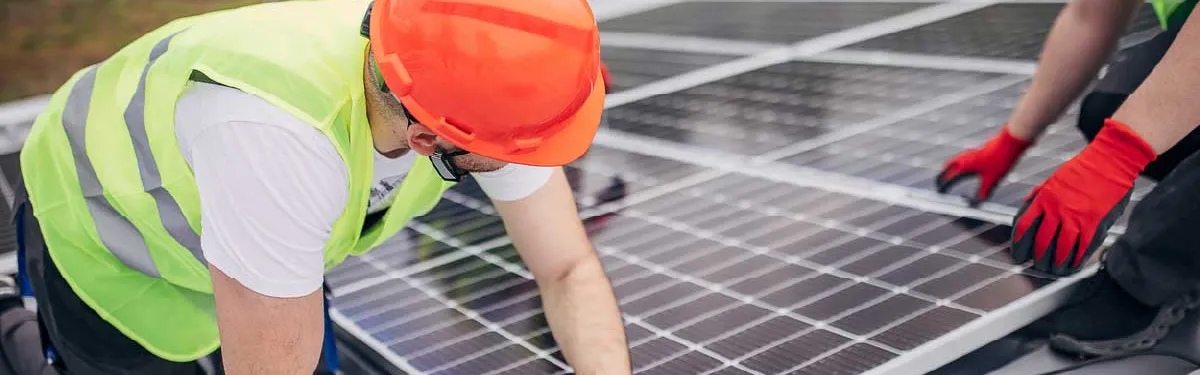
- Install solar energy systems.
- Install solar energy systems.
- Install solar energy systems.
- Maintain mechanical equipment.
- Test green technology installations to verify performance.
Work Values
Achievement
Occupations that satisfy this work value are results oriented and allow employees to use their strongest abilities, giving them a feeling of accomplishment. Corresponding needs are Ability Utilization and Achievement.
Working Conditions
Recognition
Relationships
Support
Independence
Tasks
- Install photovoltaic (PV) systems in accordance with codes and standards, using drawings, schematics, and instructions.
- Check electrical installation for proper wiring, polarity, grounding, or integrity of terminations.
- Identify electrical, environmental, and safety hazards associated with photovoltaic (PV) installations.
- Identify installation locations with proper orientation, area, solar access, or structural integrity for photovoltaic (PV) arrays.
- Assemble solar modules, panels, or support structures, as specified.
- Apply weather sealing to array, building, or support mechanisms.
- Install module array interconnect wiring, implementing measures to disable arrays during installation.
- Install required labels on solar system components and hardware.
- Diagram layouts and locations for photovoltaic (PV) arrays and equipment, including existing building or site features.
- Determine materials, equipment, and installation sequences necessary to maximize installation efficiency.
- Test operating voltages to ensure operation within acceptable limits for power conditioning equipment, such as inverters and controllers.
- Determine appropriate sizes, ratings, and locations for all system overcurrent devices, disconnect devices, grounding equipment, and surge suppression equipment.
- Activate photovoltaic (PV) systems to verify system functionality and conformity to performance expectations.
- Identify and resolve any deficiencies in photovoltaic (PV) system installation or materials.
- Visually inspect and test photovoltaic (PV) modules or systems.
- Examine designs to determine current requirements for all parts of the photovoltaic (PV) system electrical circuit.
- Demonstrate system functionality and performance, including start-up, shut-down, normal operation, and emergency or bypass operations.
- Identify methods for laying out, orienting, and mounting modules or arrays to ensure efficient installation, electrical configuration, or system maintenance.
- Measure and analyze system performance and operating parameters to assess operating condition of systems or equipment.
- Program, adjust, or configure inverters and controls for desired set points and operating modes.
- Determine connection interfaces for additional subpanels or for connecting photovoltaic (PV) systems with utility services or other power generation sources.
- Determine photovoltaic (PV) system designs or configurations based on factors such as customer needs, expectations, and site conditions.
- Select mechanical designs, installation equipment, or installation plans that conform to environmental, architectural, structural, site, and code requirements.
- Perform routine photovoltaic (PV) system maintenance on modules, arrays, batteries, power conditioning equipment, safety systems, structural systems, weather sealing, or balance of systems equipment.
- Compile or maintain records of system operation, performance, and maintenance.
- Install active solar systems, including solar collectors, concentrators, pumps, or fans.
Work Styles
Leadership
Job requires a willingness to lead, take charge, and offer opinions and direction.
Achievement/Effort
Persistence
Initiative
Cooperation
Concern for Others
Social Orientation
Self-Control
Stress Tolerance
Adaptability/Flexibility
Dependability
Attention to Detail
Integrity
Independence
Innovation
Analytical Thinking
Data Source: This page includes information from the O*NET 30.0 Database by the U.S. Department of Labor, Employment and Training Administration (USDOL/ETA). Used under the CC BY 4.0 license. O*NET® is a trademark of USDOL/ETA. This page includes Employment Projections program, Occupational Employment and Wage Statistics program, U.S. Bureau of Labor Statistics.