Colleges by Location
Colleges by Fields of Study
Colleges by Tuition Range
Colleges by GPA Range
College by SAT Range
Colleges by ACT Score
Graduate Schools by Location
Graduate Schools by Fields of Study
Graduate School by Degree Type
Paying for Graduate School
Online Graduate Programs
Test Preparation
Career Planning
College Planning
Graduate School Planning
Applying to Graduate School
- More

| Median Wage (USD, 2024) | Projected Job Openings (2023-2033) | Projected Growth (2023-2033) | |
|---|---|---|---|
| National Statistics | $67,370 | 1300 | 2.5% |
| State Statistics | - | - | - |
| City Statistics | - | - | - |
Experience Requirements Overview
- Job Zone Two: Some Preparation Needed
- Some previous work-related skill, knowledge, or experience is usually needed. For example, a teller would benefit from experience working directly with the public.
- These occupations usually require a high school diploma.
- Employees in these occupations need anywhere from a few months to one year of working with experienced employees. A recognized apprenticeship program may be associated with these occupations.
Education, Training and Experience
Required Level of Education: High School Diploma - or the equivalent (for example, GED)
Related Work Experience: N.A.
On-Site or In-Plant Training: N.A.
On-the-Job Training: None or short demonstration
Detailed Work Activities
- Locate equipment or materials in need of repair or replacement.
- Clean equipment or facilities.
- Maintain mechanical equipment.
- Maintain construction tools or equipment.
- Maintain mechanical equipment.
Work Values
Achievement
Occupations that satisfy this work value are results oriented and allow employees to use their strongest abilities, giving them a feeling of accomplishment. Corresponding needs are Ability Utilization and Achievement.
Working Conditions
Recognition
Relationships
Support
Independence
Tasks
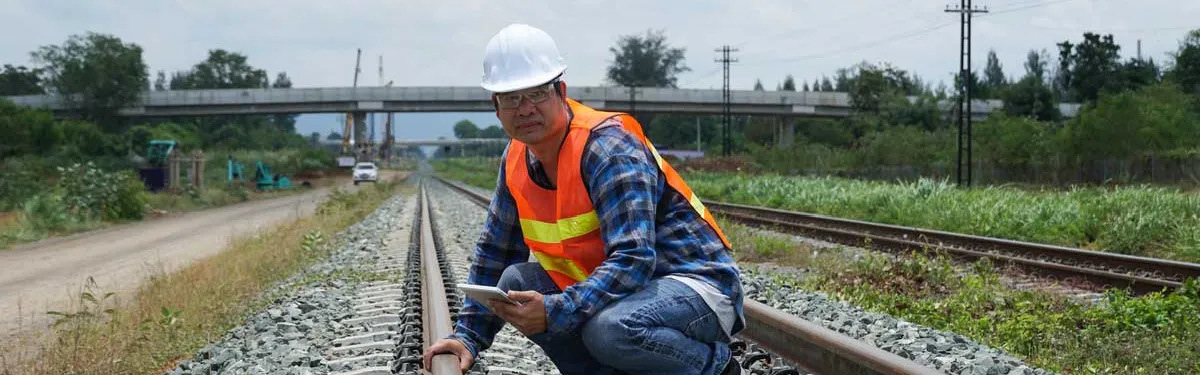
- Patrol assigned track sections so that damaged or broken track can be located and reported.
- Repair or adjust track switches, using wrenches and replacement parts.
- Weld sections of track together, such as switch points and frogs.
- Observe leveling indicator arms to verify levelness and alignment of tracks.
- Operate single- or multiple-head spike driving machines to drive spikes into ties and secure rails.
- Operate track wrenches to tighten or loosen bolts at joints that hold ends of rails together.
- Cut rails to specified lengths, using rail saws.
- Lubricate machines, change oil, or fill hydraulic reservoirs to specified levels.
- Drill holes through rails, tie plates, or fishplates for insertion of bolts or spikes, using power drills.
- Clean tracks or clear ice or snow from tracks or switch boxes.
- Clean, grade, or level ballast on railroad tracks.
- Raise rails, using hydraulic jacks, to allow for tie removal and replacement.
- Adjust controls of machines that spread, shape, raise, level, or align track, according to specifications.
- Dress and reshape worn or damaged railroad switch points or frogs, using portable power grinders.
- Clean or make minor repairs to machines or equipment.
- Grind ends of new or worn rails to attain smooth joints, using portable grinders.
- Operate single- or multiple-head spike pullers to pull old spikes from ties.
- String and attach wire-guidelines machine to rails so that tracks or rails can be aligned or leveled.
- Engage mechanisms that lay tracks or rails to specified gauges.
- Drive graders, tamping machines, brooms, or ballast spreading machines to redistribute gravel or ballast between rails.
- Drive vehicles that automatically move and lay tracks or rails over sections of track to be constructed, repaired, or maintained.
- Turn wheels of machines, using lever controls, to adjust guidelines for track alignments or grades, following specifications.
- Push controls to close grasping devices on track or rail sections so that they can be raised or moved.
- Operate tie-adzing machines to cut ties and permit insertion of fishplates that hold rails.
- Paint railroad signs, such as speed limits or gate-crossing warnings.
- Spray ties, fishplates, or joints with oil to protect them from weathering.
Work Styles
Achievement/Effort
Job requires establishing and maintaining personally challenging achievement goals and exerting effort toward mastering tasks.
Persistence
Initiative
Leadership
Cooperation
Concern for Others
Social Orientation
Self-Control
Stress Tolerance
Adaptability/Flexibility
Dependability
Attention to Detail
Integrity
Independence
Innovation
Analytical Thinking
Data Source: This page includes information from the O*NET 30.0 Database by the U.S. Department of Labor, Employment and Training Administration (USDOL/ETA). Used under the CC BY 4.0 license. O*NET® is a trademark of USDOL/ETA. This page includes Employment Projections program, Occupational Employment and Wage Statistics program, U.S. Bureau of Labor Statistics.