Colleges by Location
Colleges by Fields of Study
Colleges by Tuition Range
Colleges by GPA Range
College by SAT Range
Colleges by ACT Score
Graduate Schools by Location
Graduate Schools by Fields of Study
Graduate School by Degree Type
Paying for Graduate School
Online Graduate Programs
Test Preparation
Career Planning
College Planning
Graduate School Planning
Applying to Graduate School
- More

| Median Wage (USD, 2024) | Projected Job Openings (2023-2033) | Projected Growth (2023-2033) | |
|---|---|---|---|
| National Statistics | $58,140 | 8500 | 3.3% |
| State Statistics | - | - | - |
| City Statistics | - | - | - |
Experience Requirements Overview
- Job Zone Two: Some Preparation Needed
- Some previous work-related skill, knowledge, or experience is usually needed. For example, a teller would benefit from experience working directly with the public.
- These occupations usually require a high school diploma.
- Employees in these occupations need anywhere from a few months to one year of working with experienced employees. A recognized apprenticeship program may be associated with these occupations.
Education, Training and Experience
Required Level of Education: Less than a High School Diploma
Related Work Experience: Over 1 year, up to and including 2 years
On-Site or In-Plant Training: Over 2 years, up to and including 4 years
On-the-Job Training: Over 2 years, up to and including 4 years
Detailed Work Activities
- Measure materials or objects for installation or assembly.
- Mark reference points on construction materials.
- Review blueprints or specifications to determine work requirements.
- Install building fixtures.
- Mark reference points on construction materials.
Work Values
Achievement
Occupations that satisfy this work value are results oriented and allow employees to use their strongest abilities, giving them a feeling of accomplishment. Corresponding needs are Ability Utilization and Achievement.
Working Conditions
Recognition
Relationships
Support
Independence
Tasks
- Coordinate work with drywall finishers who cover the seams between drywall panels.
- Read blueprints or other specifications to determine methods of installation, work procedures, or material or tool requirements.
- Measure and mark surfaces to lay out work, according to blueprints or drawings, using tape measures, straightedges or squares, and marking devices.
- Fit and fasten wallboard or drywall into position on wood or metal frameworks, using glue, nails, or screws.
- Measure and cut openings in panels or tiles for electrical outlets, windows, vents, plumbing, or other fixtures, using keyhole saws or other cutting tools.
- Assemble or install metal framing or decorative trim for windows, doorways, or vents.
- Cut metal or wood framing and trim to size, using cutting tools.
- Inspect furrings, mechanical mountings, or masonry surfaces for plumbness and level, using spirit or water levels.
- Cut fixture or border tiles to size, using keyhole saws, and insert them into surrounding frameworks.
- Cut and screw together metal channels to make floor or ceiling frames, according to plans for the location of rooms or hallways.
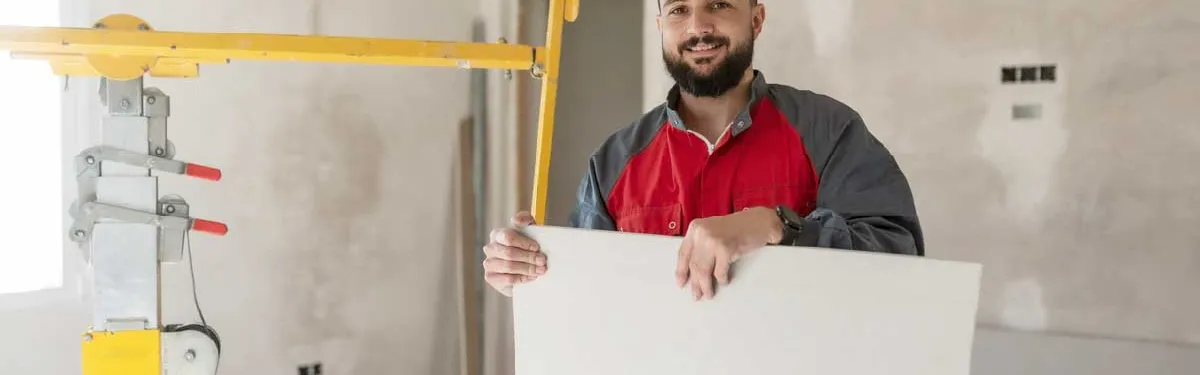
- Hang drywall panels on metal frameworks of walls and ceilings in offices, schools, or other large buildings, using lifts or hoists to adjust panel heights, when necessary.
- Trim rough edges from wallboard to maintain even joints, using knives.
- Suspend angle iron grids or channel irons from ceilings, using wire.
- Install horizontal and vertical metal or wooden studs to frames so that wallboard can be attached to interior walls.
- Scribe and cut edges of tile to fit walls where wall molding is not specified.
- Hang dry lines to wall moldings to guide positioning of main runners.
- Fasten metal or rockboard lath to the structural framework of walls, ceilings, or partitions of buildings, using nails, screws, staples, or wire-ties.
- Install blanket insulation between studs and tack plastic moisture barriers over insulation.
- Seal joints between ceiling tiles and walls.
- Remove existing plaster, drywall, or paneling, using crowbars and hammers.
- Apply or mount acoustical tile or blocks, strips, or sheets of shock-absorbing materials to ceilings or walls of buildings to reduce reflection of sound or to decorate rooms.
- Mount tile, using adhesives, or by nailing, screwing, stapling, or wire-tying lath directly to structural frameworks.
- Nail channels or wood furring strips to surfaces to provide mounting for tile.
- Install metal lath where plaster applications will be exposed to weather or water, or for curved or irregular surfaces.
- Apply cement to backs of tiles and press tiles into place, aligning them with layout marks or joints of previously laid tile.
- Wash concrete surfaces before mounting tile to increase adhesive qualities of surfaces, using washing soda and zinc sulfate solution.
Work Styles
Achievement/Effort
Job requires establishing and maintaining personally challenging achievement goals and exerting effort toward mastering tasks.
Persistence
Initiative
Leadership
Cooperation
Concern for Others
Social Orientation
Self-Control
Stress Tolerance
Adaptability/Flexibility
Dependability
Attention to Detail
Integrity
Independence
Innovation
Analytical Thinking
Data Source: This page includes information from the O*NET 30.0 Database by the U.S. Department of Labor, Employment and Training Administration (USDOL/ETA). Used under the CC BY 4.0 license. O*NET® is a trademark of USDOL/ETA. This page includes Employment Projections program, Occupational Employment and Wage Statistics program, U.S. Bureau of Labor Statistics.